Curriculum & Pedagogy
Rooted in Rhythm, Wonder, and the Whole Child

At Sun Mountain Community School, the curriculum unfolds like the child—organically, rhythmically, and with reverence for the unfolding human being. Inspired by the principles of Waldorf education and guided by the developmental stages of childhood, we offer a rich, arts-integrated education that nourishes the intellect, stirs the heart, and awakens the will.
We begin not with textbooks, but with living experiences: story, movement, nature, song, and handwork. As children grow, so does the complexity of their learning—deepening into scientific observation, historical inquiry, artistic expression, and inner reflection. All along, beauty and meaning are interwoven with academic rigor.
“Receive the children in reverence, educate them in love, and send them forth in freedom.”
— Rudolf Steiner
Early Childhood (Pre-K & Kindergarten)
Building Foundations Through Play, Imitation, and Nature
Our Early Childhood classrooms are warm, nurturing environments designed to feel like an extension of home. In these formative years, children learn best through imitation, movement, and meaningful sensory experience. Unhurried and protected, each day follows a gentle rhythm: baking bread, singing together, storytelling, watercolor painting, gardening, sweeping, and free play in nature.
Core Elements:
- Free play and social-emotional learning
- Nature walks and seasonal festivals
- Purposeful work using natural materials (sweeping, cooking, handcrafts)
- Oral storytelling to strengthen language, imagination, and memory
“In the early years, we protect the magic of childhood. Learning comes through the hands and heart.”
To learn more about our early childhood program, visit our Enchanted Playgarden page.
Grades 1–3
Stories, Structure & the Wonder of Discovery
As children enter the grades, the world opens through story. Fairy tales, fables, and legends become vessels for introducing language, number, science, and geography. All subjects are brought through vivid imagery, movement, drawing, and song—supporting both intellectual development and emotional harmony.
Academic Focus:
- Foundational reading, writing, and math
- Nature studies, farming, and local geography
- Form drawing, handwork, and watercolor painting
- Practical arts: knitting, gardening, beeswax modeling
Waldorf Integration:
- Main Lesson Books created by each student as personal expressions of learning
- Daily music and movement (including singing and eurythmy)
- Imaginative storytelling as a pedagogical foundation
Grades 4–6
Awakening Individuality & Deepening Understanding
In middle childhood, students begin to perceive the world with greater clarity and logic. The curriculum responds with greater depth: scientific observation, regional and world geography, historical inquiry, and increasingly abstract math. Children still learn through art, movement, and story—but are now asked to reflect, analyze, and articulate.
Academic Focus:
- Norse myths, ancient civilizations, and local history
- Fractions, decimals, geometry, and measurement
- Zoology and botany through observation and illustration
- Independent projects and growing writing skills
Waldorf Integration:
- More refined and structured written work
- Recorder, chorus, and introduction to string instruments
- Evolving handwork: crochet, cross-stitch, embroidery, and woodwork
- Class plays that reflect curricular and social-emotional themes
“To truly know the world, look deeply within your own being; to truly know yourself, take real interest in the world.”
— Rudolf Steiner
Grades 7–8 (Coming Soon)
Thinking, Questioning & Becoming
Adolescence marks a time of great transformation. As young people seek truth, identity, and purpose, our curriculum meets them with depth and challenge. Students will engage in critical thinking, creative expression, and real-world inquiry—balancing intellectual rigor with social connection and inner exploration.
Planned Academic Focus:
- Algebra, geometry, chemistry, and physics
- Renaissance, revolutions, and biographies of changemakers
- World geography and cultural studies
- Debate, expository and creative writing
Practical arts: woodworking, fiber arts, cooking
Waldorf Integration:
- Integration of social justice themes and current events
- Continued development in music, art, and theater
- Capstone projects and public presentations
- Deep mentorship and community-building practices
“The heart of the Waldorf method is that education is an art—it must speak to the child’s experience. To educate the whole child, their heart and will must be reached, as well as the mind.”
— Rudolf Steiner
Learning Through the Seasons
Living Education in Rhythm with the Earth
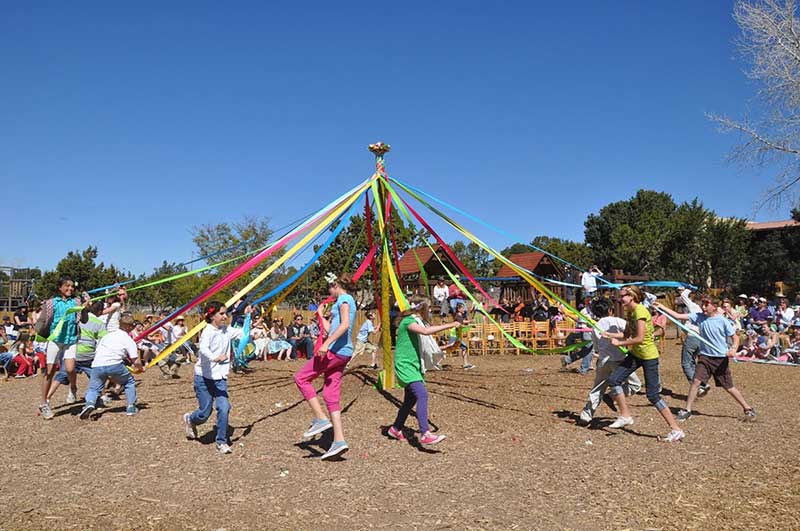
At Sun Mountain, the year is shaped not only by academic milestones, but by the turning of the seasons. Our students plant and harvest, gather for festivals, hike the nearby trails, and mark solstices and equinoxes with community and ceremony. These rhythms connect the inner life of the child to the outer world—fostering gratitude, presence, and a felt sense of belonging.
“What we introduce into the children’s world of ideas and feelings must align with the direction of the developmental forces of a given stage of life.”
— Rudolf Steiner

Blog & Latest News
Knitting: A Hands-On Lesson in Patience and Creativity
Knitting: A Hands-On Lesson in Patience and CreativityIn Waldorf education, knitting is far more than a handcraft—it’s a deeply meaningful developmental practice. As children loop…
Honoring Childhood’s Pace
Honoring Childhood’s PaceChildhood is not a race—it’s a sacred unfolding. In a world that often urges children to move faster, achieve more, and grow up…
The Nine-Year Change: A Milestone of Growth
Understanding the Nine-Year ChangeAround the age of nine, many children undergo a profound internal transformation—what Waldorf educators refer to as “the nine-year change.” During this…